 PARDES
The Talmud was always yours. Take a few minutes a day and open it.
The day's page with Rashi and Tosafot, the library around it, and a set time each day to open it. No background needed. Nobody asking whether you're religious.
Launching in weeks. You'll hear from us the day it's out. Nothing else is ever sent to this address.
- An AI chavrutaTap a line and ask. It cites the page.
- Context firstWhere you are, before you begin.
- 218 booksTanakh to Kabbalah, with commentaries.
- A daily planAt your pace. It rests on Shabbat.

Stuck on a line? Tap it, and ask.
An AI study partner that reads the page in front of you, answers from it and from the commentaries around it, and ends every answer with what it read.
- You choose who answers: Talmid, Avrech or Rav, by plan.
- The price in credits is shown before you ask, never after.
- It learns with you on the page, not instead of it.
Optional, from $4.99 a month, bought in the iPhone or Android app and renewed monthly until cancelled. The library stays free. See the plans
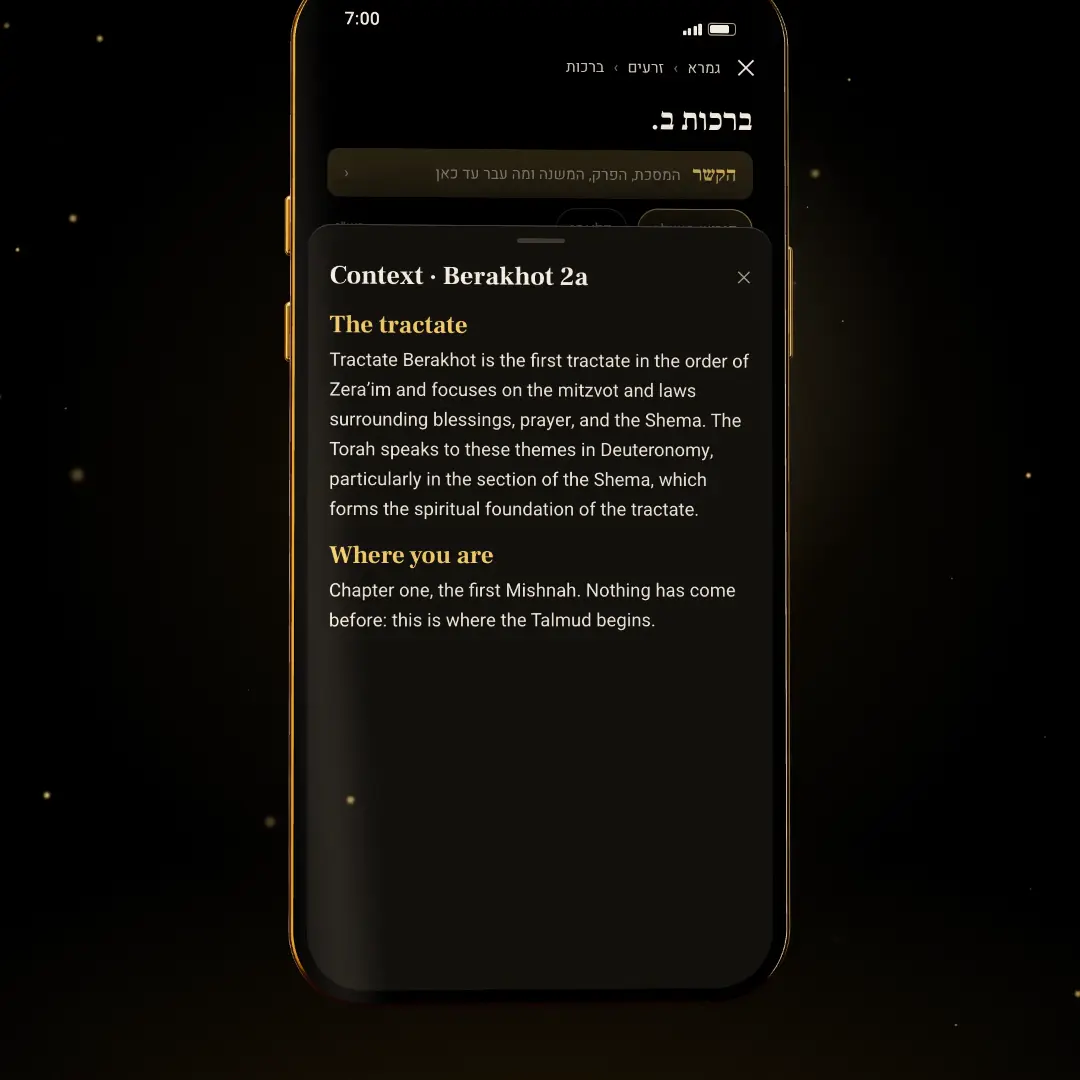
The day's page, the way it is printed.
Rashi and Tosafot under every line. Context a tap away.
The Daf Yomi each day, with the Steinsaltz elucidation a tap away. Tap Context and a sheet rises with the tractate and where you are in it, so you never open a page cold, even mid-tractate.
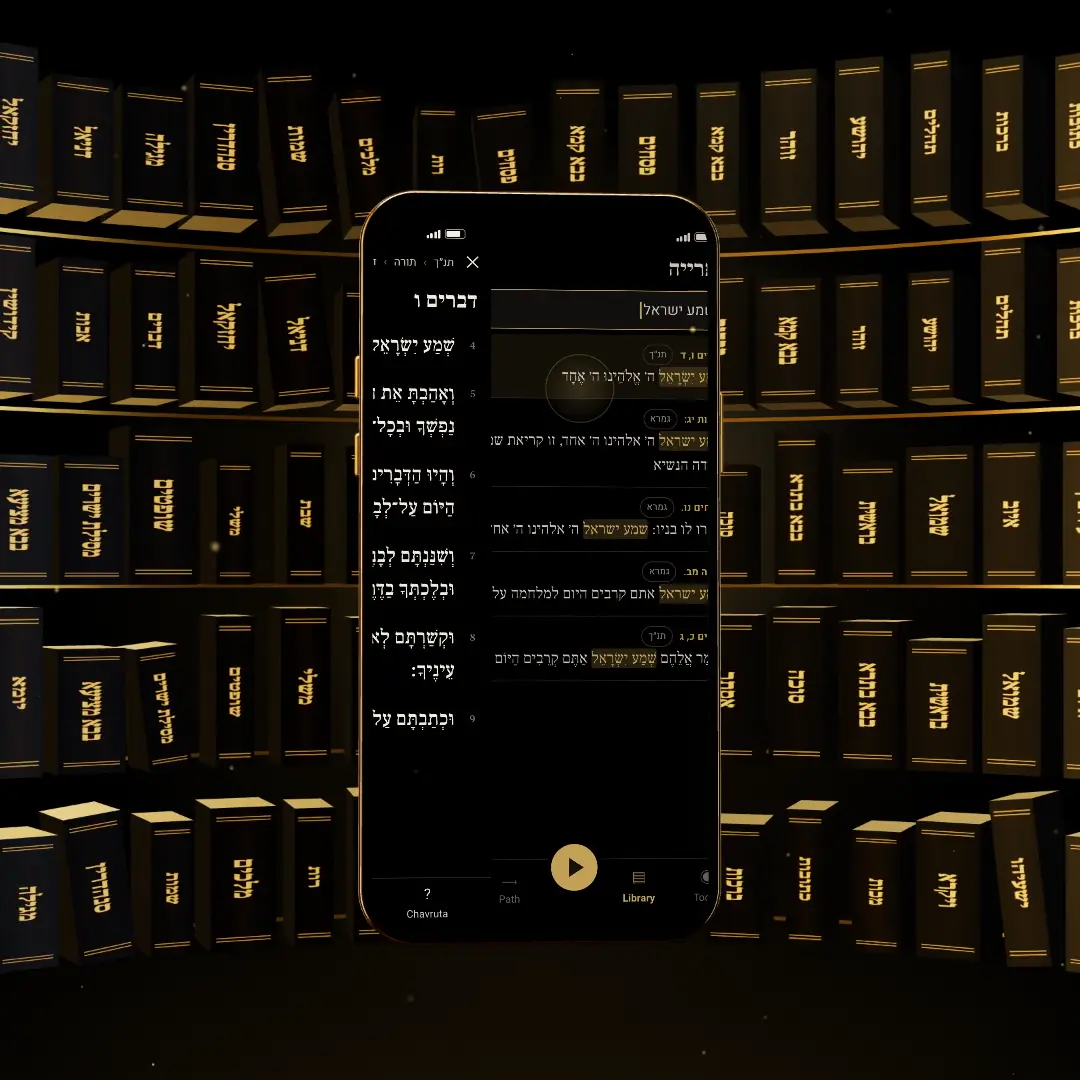
218 books, one pocket.
Search a reference or a phrase, and the page opens.
Tanakh with Rashi, Ramban and Ibn Ezra. All 63 tractates of Mishnah with Bartenura. The whole Bavli. The Kabbalah and Musar shelves. Free, with no account.
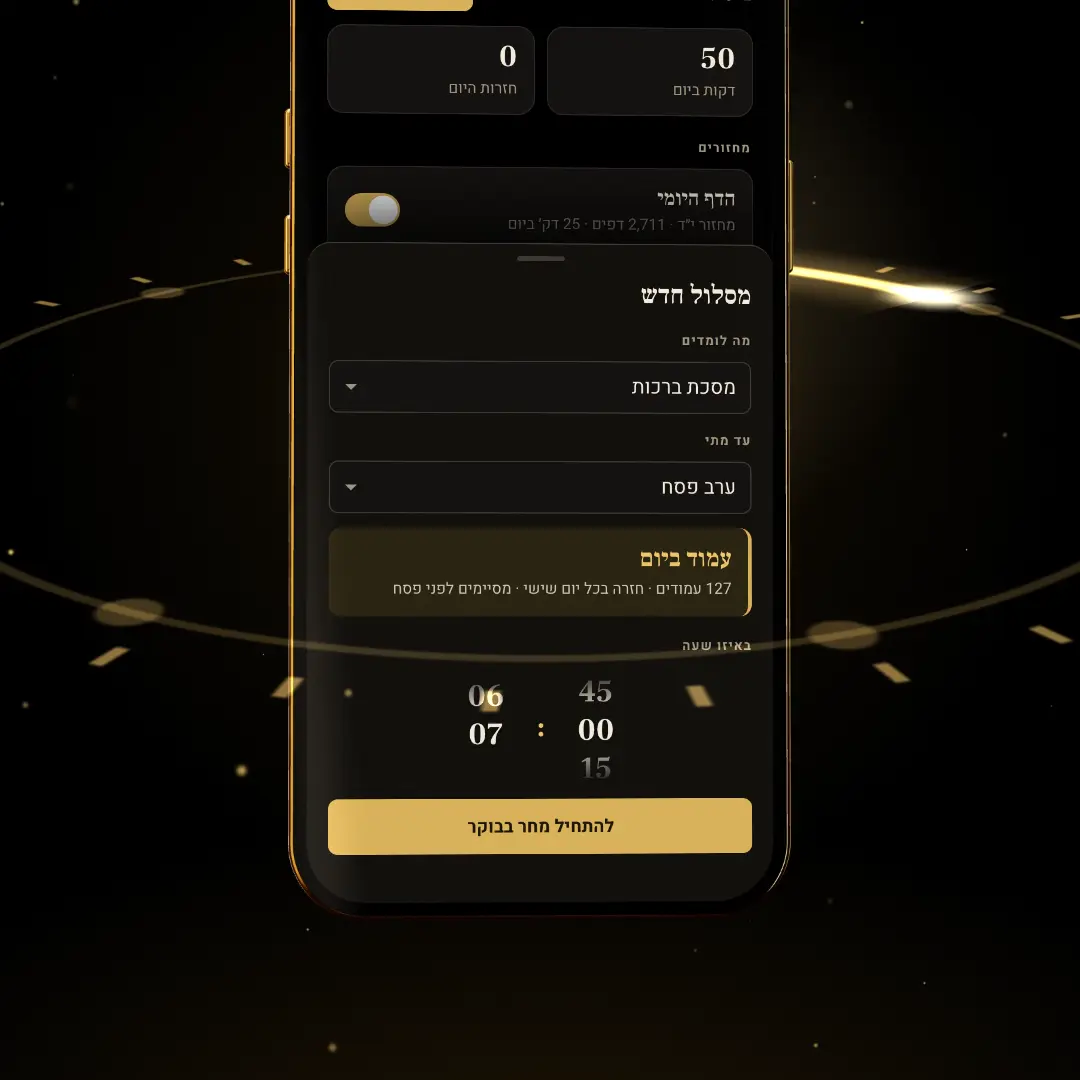
A daily plan that holds.
Pick a book and a finish date. It works out the pace.
Review days on the Hebrew calendar, missed days never shown in red, and a reminder at the time you set in the phone app. On Shabbat and Yom Tov, the plan rests.
A set time, every day. The page does the rest.
The Daf Yomi, the week's Parasha, Tehillim, or a plan of your own: a book or a tractate, at your pace. Then the time of day you learn. Change either whenever you like.
The text the way it is printed, with its commentaries underneath. When you reach the end, say you're done. That is what counts the day.
The phone app reminds you at the time you set, and stays quiet on Shabbat and Yom Tov. The web app keeps the time on its home screen. The week fills in as you go.
The quiet details
A set time, and a reminder
Choose the time you learn. In the phone app the reminder is scheduled by your phone itself; nothing about it goes to a server, and none comes on Shabbat.
Links, found by code
In Genesis, Psalms, Berakhot and Chullin so far, tap a line to see where it is quoted and what it quotes. A verse opens the sugya that reads it; the sugya opens the verse.
The library needs no account
No email, no password. Your plans, bookmarks and notes are kept on your device, and none of it is sent to us.
Every reader above opens in your browser right now. The app adds the daily path, your plans, the set time and the quiet.
Everything that teaches is free. There are no ads, and there never will be.
The library with its commentaries, the daily learning, your own plans and a set time to open them. No ads, no account.
An AI study partner you can ask about the line in front of you. A monthly plan, bought in the iPhone or Android app. See the plans.
Some of the editions are licensed for non-commercial use, and that is how we use them: free, with their credits, which the app lists in full.
Why a few people in Israel are building this
Because the distance is real. Between here and where you live, between the generation that learned and the one that didn't, between the people who were handed these books and the people who were handed the idea that the books weren't for them. Plenty of men come to it at forty because there is a son with a bar mitzvah coming and nothing to hand him. That is as good a reason as any, and better than most.
We can't close all of that distance. We can put the page in your hand every day, with nothing between you and it, and make the next day a little easier to come back to. Read a page. If it was worth it, send it to someone. That is honestly how this grows.
Questions people ask us
Is this for religious people?
It's for anyone who wants to read the text. Nothing in the app asks what you keep or believe. Plenty of people learning Daf Yomi are secular, or unsure, or somewhere in between.
Do I need an account?
Not for the library. Only the chavruta, the paid AI study partner, needs a Google sign-in. Your plans, set times, bookmarks and notes stay on your device, which also means they don't follow you to a second one.
Is it really free?
The library is, all of it: the texts, the commentaries and the plans to learn by, with no ads. One thing is sold, and it is optional: the chavruta, an AI study partner, on a monthly plan in the app.
What happens on Shabbat?
The app goes quiet, from candle lighting to havdalah, by the city you choose. No reminders come, and the texts stay open to read.
A few minutes. Today's page. Nobody asks who you are.
One email when it launches. Nothing else is ever sent.